Metisnetwork scales Ethereum apps through specialized networks and the Metis SDK
Metisnetwork is the Metis ecosystem of Ethereum scaling networks and development tools, including Andromeda, Hyperion, LazAI and the Metis SDK. Andromeda supports general-purpose decentralized applications, while Hyperion focuses on parallel execution and AI-related workloads. Gas costs depend on the selected network and contract work, while testnet tokens and fee-abstraction features serve different purposes from ordinary production gas payments.
Last updated -
On this page
Ethereum Virtual Machine (EVM) compatibility connects the platform to existing Ethereum software. Network choice also determines where an application runs, which infrastructure processes its transactions and how its costs relate to Ethereum settlement.
Can Ethereum Apps Run on Metis?
Ethereum applications can run in Andromeda's EVM-compatible environment, while Hyperion combines Ethereum compatibility with specialized execution components. The EVM defines the contract execution model familiar to Ethereum developers, so existing contract logic and development practices remain relevant across the networks. A deployment also needs network connections and application dependencies appropriate to its destination.
The application determines which network capabilities matter. General-purpose contracts fit Andromeda's established application focus, while workloads involving frequent interactions or intensive computation make Hyperion's execution design relevant. Both belong to the broader Metis platform, whose development tools also support specialized network construction. Ethereum compatibility alone does not establish identical costs, performance or operating controls across these environments.
Gas Charges and Fee Funding
Andromeda uses METIS to pay ordinary transaction gas, and contract execution determines how much computational work a transaction requires. Gas measures that work, and the fee expresses its cost under the network's pricing rules; token transfers and complex contract interactions can require different resources. Low-cost execution is a platform objective, but no single permanent fee describes every application operation. A meaningful estimate belongs to the selected network and the exact contract call.
Execution and Network Costs
Execution Demand
Contract logic influences resource consumption through computation and state access, with repeated storage operations introducing different demands from calls performing less work. Gas optimization therefore concerns the application itself as well as the chain it uses. A faster execution engine does not automatically remove the work a contract requests.
Network Conditions
Network fee settings determine how the chain prices execution, while settlement and data handling contribute to the broader scaling design. Application charges and cross-chain fees have separate purposes from the gas funding a local contract call. Moving assets between networks can introduce additional costs specific to the transfer mechanism and networks involved.
Sponsored Transactions
Andromeda's account-abstraction integrations can support sponsored transactions through smart-contract wallets and a configured paymaster or relayer. Sponsorship assigns the fee to another payer, such as the application, under that service's rules, while the transaction still consumes network resources. Access depends on the particular wallet, integration and operation the sponsor supports.
Layer 2 Execution and Ethereum Settlement
Metis scaling combines Layer 2 execution with Ethereum-facing settlement infrastructure, including Hyperion's optimistic rollup design. A rollup performs transaction work outside Ethereum's main execution environment and connects the resulting state to Layer 1. Hyperion's settlement design periodically submits state commitments to Ethereum. This arrangement separates the computation an application requests from the network recording its commitments. The applicable verification contracts, data availability and dispute mechanisms determine the design's security assumptions.
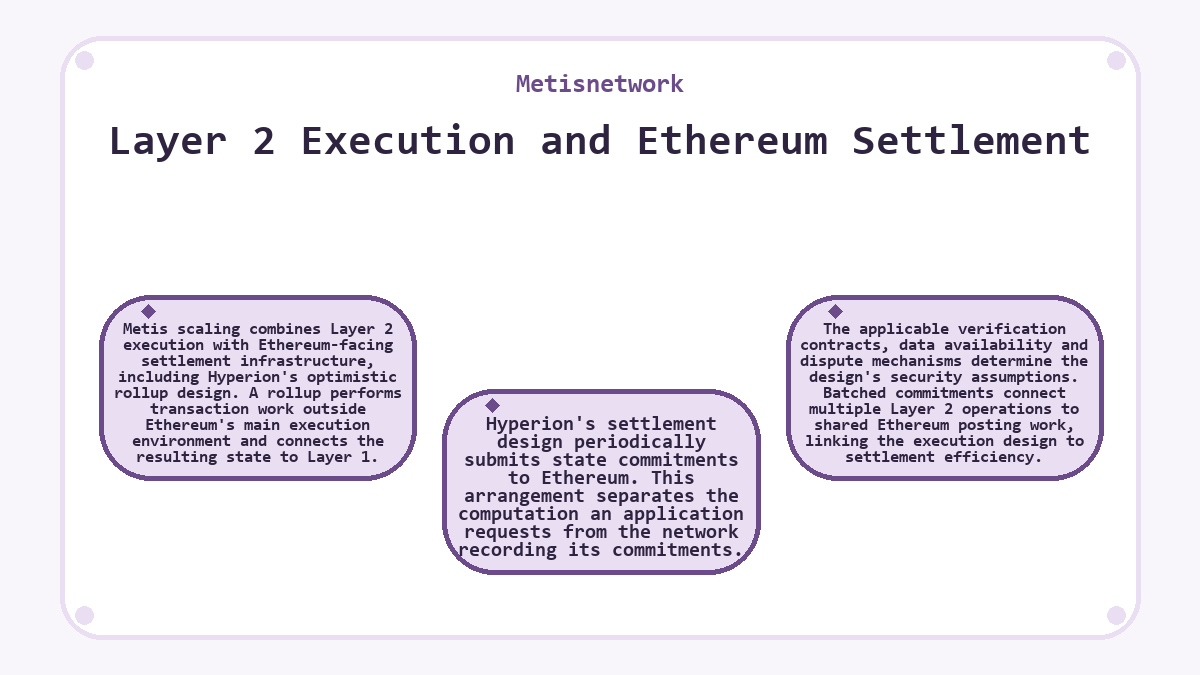
Batched commitments connect multiple Layer 2 operations to shared Ethereum posting work, linking the execution design to settlement efficiency.
Andromeda's General-Purpose Apps
Andromeda supports decentralized applications across DeFi, NFTs and decentralized autonomous organizations (DAOs). These uses share a need for contract execution and network state, even when their application rules differ. DeFi contracts handle financial operations and NFT applications manage tokenized ownership records, while DAOs use contracts to organize collective decisions and related actions. The network supplies execution infrastructure, while each application defines its own functions and permissions. Contract permissions determine which accounts can perform restricted actions, and application-specific charges can add to the gas required for execution.
How Does Parallel Execution Help Hyperion Apps?
Hyperion's parallel execution processes independent transaction work concurrently to improve throughput, while preserving the ordering dependencies shared state creates. Independent operations offer opportunities for concurrent processing, whereas transactions accessing conflicting state require coordination so execution produces consistent results. A contract with many independent operations presents different scheduling opportunities from one concentrating activity around the same state.
MetisVM is Hyperion's Ethereum-compatible execution engine, with dynamic opcode optimization, speculative execution and state-aware caching addressing instruction handling and repeated access to execution data. AI infrastructure support includes inference-engine optimization, virtual-machine precompiles and host functions. These facilities target computationally intensive on-chain inference, alongside the virtual machine's general contract-execution role.
MetisDB addresses state management through memory-mapped Merkle trees, multi-version concurrency control and asynchronous input/output. Multi-version concurrency control supports concurrent state updates, while asynchronous operations reduce dependence on completing storage tasks sequentially. MetisVM handles execution and MetisDB manages storage, with both contributing to the responsiveness of gaming, DeFi and on-chain AI applications. Application dependencies and state contention still influence the performance a particular workload can achieve.
Hyperion Transaction Processing and Control
Hyperion's transaction architecture separates user authorization from execution and periodic Ethereum commitments, placing the execution engine and storage components at different points in the processing flow.
| Transaction Stage | Processing Responsibility |
|---|---|
| Mempool Intake | The user submits a signed transaction; network software queues it. |
| Batch Ordering | The sequencer places the transaction within an ordered batch. |
| Dependency Analysis | The execution framework identifies dependencies before parallel processing. |
| Contract Execution | The virtual machine and parallel framework process the transaction. |
| State Update | MetisDB records the resulting network state. |
| Local Confirmation | The network returns transaction confirmation to the user. |
| Ethereum Commitment | The settlement infrastructure periodically submits state commitments to Ethereum. |
Local confirmation reports the Layer 2 result, followed by later Ethereum commitments. Ordering protections depend on the network implementation and deployed release.
Sequencers, Verifiers and Data Availability
Andromeda's architecture assigns transaction ordering and block propagation to sequencers, with verifiers examining the validity of sequencer data and Ethereum smart contracts providing the architectural route for resolving disputes. User authorization gives permission for a transaction, while the sequencer organizes network activity and contract execution determines the requested state changes.
Andromeda's decentralized sequencing distributes ordering responsibilities across participating nodes, aiming to improve resilience and reduce dependence on one ordering operator. Hyperion's decentralized sequencing design includes leader rotation and timeout-based failover. Its overview presents decentralized sequencing as a future release without an activation date. Rotation changes the ordering leader, while failover addresses an unavailable leader. Deployment-specific controls determine which mechanisms operate on a particular network; the design alone does not establish universal censorship or manipulation protection.
Verification, upgrade authority and transaction-data availability introduce additional assumptions in the overall network design.
In Andromeda's 2022 storage design, Memolabs stored transaction data separately from the sequencer's ordering role. A May 2025 announcement scheduled Ethereum blob data availability and fraud proofs for May 14, 2025. The December 2025 roadmap also listed fraud-proof activation and completion of blob migration as 2026 milestones. These announcements leave the active data-availability and dispute configuration unconfirmed. Data availability concerns access to the information needed to inspect and reconstruct network activity. Its implementation matters independently of execution speed.
The Metis SDK and LazAI
The Metis SDK is a software development kit for constructing specialized blockchain networks within the broader platform, supplying programmable infrastructure for components appropriate to their intended applications. Hyperion demonstrates how the SDK supports intensive execution workloads. Shared tooling allows related projects to reuse infrastructure without making their execution models or intended uses identical.
LazAI focuses on AI data alignment and an architecture for verifiable, tokenized and composable AI assets and interactions. Its 2025 architecture described Application, Execution and Extension layers. The execution layer used an EVM-compatible engine named LazVM for AI computations and gas settlement. That design also specified quorum-based Byzantine Fault Tolerance consensus. These details distinguish LazAI's AI and data responsibilities from Hyperion's execution-performance focus, while connecting both to the Metis development framework.
Community Ecosystem Governance and Project Support
Community Ecosystem Governance (CEG) gives the Metis community a voting framework for ecosystem decisions, including project verification and selection for marketing support. Community Verified Project (CVP) status connects projects to community engagement, promotion and funding opportunities. These activities concern project participation and support rather than the consensus validating a network's state. A community vote can influence which projects receive ecosystem attention, while the projects retain their own application functions.
Network Access and Application Fit
Wallet connections, node access and bridges connect applications and users to the appropriate Metis environment. Bridging supports asset movement between Ethereum and Metis Layer 2, with support depending on the selected mechanism and destination. A shared ecosystem does not establish every asset or network combination. Hyperion's testnet configuration uses chain ID 133717 and the currency symbol tMETIS. Those identifiers describe a test environment, not a substitute for another network's settings. Network configuration determines which ledger receives an application's transactions.
Direct Ethereum deployment uses Layer 1 execution, while Metis adds network-specific execution and settlement infrastructure around the familiar Ethereum contract model.
Your questions, answered
Why Can a Wallet Show a Balance While an Andromeda Transaction Lacks Gas?
An Andromeda wallet needs METIS on Andromeda to fund an ordinary transaction, even when it holds other token balances. Another token balance or METIS held on a different network does not supply that local gas balance. The gas-paying token and the asset a contract handles have different roles. A sponsored wallet operation can assign payment to another party when the app supports the relevant transaction.
Do I Need to Operate a Sequencer to Use an Andromeda App?
Using an Andromeda application does not require operating a sequencer node. Users authorize transactions, while node operators handle the infrastructure responsible for ordering and block production. Sequencer participation concerns operating network infrastructure and meeting its participation conditions. Ordinary application access concerns the user's wallet, the selected network and the contract interaction.
Does the Metis SDK Make the METIS Token Programmable?
The Metis SDK supplies programmable development tools; it does not transform the METIS token itself into application logic. Developers use the framework to build network infrastructure and applications.
How Does EVM Compatibility Affect an application's Existing Contract State?
EVM compatibility provides a compatible execution model without automatically copying an application's Ethereum state into another network. The EVM concerns how contracts execute, while a chain maintains its own deployed instances and stored state. An application needs deployment details and dependencies appropriate to its destination. State migration or cross-chain communication requires the mechanism supporting that operation, independently of the common execution model.
Is a Community Verified Project Guaranteed to Receive Grant Funding?
Community Verified Project status offers support opportunities without guaranteeing a grant payment. Project verification, selection for marketing support and funding allocation have different purposes. CVP support includes community engagement and promotion, while funding opportunities concern possible allocations. Status alone does not promise a particular award or automatic disbursement.
Will an AI Application Run Only on Hyperion Within the Metis Ecosystem?
AI applications can also use Andromeda when their contract requirements fit its EVM environment. Hyperion specializes in parallel execution and computationally intensive workloads, while an AI application may only need ordinary on-chain contract operations. LazAI adds an AI-data alignment role within the broader platform. The chosen environment must support the contracts and computation the application requires.
Where Do Testnet tMETIS Tokens Fit in the Metis Token System?
tMETIS is the transaction currency of Hyperion's testnet environment, which uses chain ID 133717. It funds testing within that network. A testnet balance does not supply a production-network gas balance or establish production fees. Contract tests concern the configuration they run against; their success does not establish identical behavior under a different deployment, fee setup or available feature set.