Metisnetwork sequencers order Andromeda transactions while rotation and consensus establish L2 finality
Metisnetwork sequencers order Andromeda transactions into blocks, with sequencer rotation and consensus from two-thirds of the pool establishing finality for the L2 block number. The active sequencer receives signed transactions, assembles blocks and broadcasts them to peers, which check its signature. Batch signing and submission then connect the L2 record to Ethereum. An application needing finalized blockchain state requires confirmation beyond the first execution receipt. A transaction receipt reports execution within a block, while the finalized L2 height reflects the pool's consensus condition. If the active sequencer fails, the consensus layer chooses a replacement. Producer recovery and transaction finality therefore require different evidence.
Last updated -
In short: Andromeda submits batches about every 30 minutes when L2 blocks reach finality, so this cadence cannot promise individual completion times.
Normal Block Production and Sequencer Reselection
Andromeda's transaction path runs through the active sequencer during normal operation; a missed ordering window moves recovery into the proof-of-stake (PoS) layer, which selects a replacement producer.
Signed Transactions and Peer Verification
Signed L2 transactions first enter the remote procedure call (RPC) network. The Bridge & Adapter coordinates with the PoS layer to reach the current sequencer's transaction pool. That sequencer forms a block and broadcasts it across the peer-to-peer network. Other sequencers verify its signature before saving the received block.
Reselection After a Sequencer Fault
A sequencer missing its ordering window or initiating transactions with duplicate L2 TxIDs can trigger reselection. The PoS layer chooses a replacement, and multi-party computation (MPC) signing supports the update to the L2 sequencer list. Rotation handling can hold an ordinary transaction while the node applies the current sequencer-set update. Processing then follows the refreshed state.
When Does an Andromeda Block Reach L2 Finality?
Andromeda's sequencer pool considers an L2 block number finalized after rotation and consensus from two-thirds of the sequencers. The denominator is the sequencer pool. Inclusion places a transaction in a block, while L2 finality concerns agreement on the chain's finalized block number. A newer visible block can therefore represent a different confirmation stage from a finalized height.
Staking Weights and Rotation Records
Sequencer selection uses voting power derived from locked METIS, so an operator's probability depends on its share of total voting power. Andromeda's weighted selection process chooses producers for a span using those relative weights. Equal membership therefore does not imply equal selection probability. The PoS layer bases rotation on staking information from Ethereum, while the L2
MetisSequencerSet
contract records the list nodes follow. This links L1 staking information to authority to produce L2 blocks. Pool membership and selection as the current producer concern different parts of that relationship.
Batch Signing and Ethereum Commitments
Ethereum anchoring requires signed batch records, so the batcher prepares batches for MPC signing before the network submits the associated L2 state commitments to Layer 1. The batcher, consensus layer and verifier perform different jobs.
Batch Data and State Roots
The batcher prepares transaction batch data and state root batch data. Transaction records describe operations in the L2 blocks; a state root commits to the resulting blockchain state. The CanonicalTransactionChain maintains ordered transaction records, while state-commitment structures record commitments to the L2 chain.
Coordinated MPC Signing
MPC allows sequencer participants to coordinate a batch signature. The PoS layer checks the sequencer's batch transaction signature and initiates MPC signing. After signing, the batch can proceed to Ethereum. This signature concerns the batch submission, with its own participating nodes and key management. A user's signature authorizes the individual transaction earlier in the processing path.
The State Commitment Chain
The State Commitment Chain (SCC) on Ethereum records cryptographic commitments to Andromeda's L2 state. A verifier synchronized with Ethereum checks batch integrity and the alignment of finalized block numbers across layers. Andromeda's processing model places batch submissions approximately every 30 minutes when L2 blocks reach finality. That cadence cannot specify when a newly submitted transaction will meet an application's completion requirement.
Receipts, Execution Status and Finalized Heights
An Andromeda transaction receipt describes an included transaction's execution and containing block, while the finalized height concerns the network's consensus over blocks. Standard EVM receipt status values distinguish success from failure:
0x1
denotes success and
0x0
denotes failure. The receipt's block number identifies the height whose finality matters. Successful execution can answer a contract-level question before later confirmation checkpoints matter to the application. A finalized failed transaction still records failed execution; finality does not convert it into a successful operation.
A missing receipt means the queried node returned no receipt for that hash; it does not identify the cause. The transaction may still be pending. Finalized-height information must concern the same chain and block history as the receipt. Ethereum anchoring additionally concerns the matching batch commitment. An unrelated successful Ethereum transaction provides no confirmation for the Andromeda block.
Andromeda and Hyperion Sequencer Scope
Andromeda's sequencer pool finality conditions apply to Andromeda, while Hyperion has a separate networking and consensus design. Hyperion's design includes leader rotation, timeout failover and BLS multisignatures for quorum certificates. Its parallel execution framework concerns how transactions access shared state during computation. Those execution dependencies differ from choosing the sequencer responsible for transaction ordering. A quorum certificate belongs to Hyperion's consensus design; Andromeda's MPC-signed Ethereum batches follow Andromeda's processing model. The Andromeda rotation threshold does not supply a universal Hyperion finality rule.
Checks for a Delayed Andromeda Transaction
A successful receipt with a block awaiting finality calls for monitoring that block's consensus status. A missing receipt leaves execution unresolved. If the active producer has missed its ordering window, protocol reselection must update the sequencer role before regular processing continues. That fault concerns the producer, so repeating the wallet action does not complete the network repair.
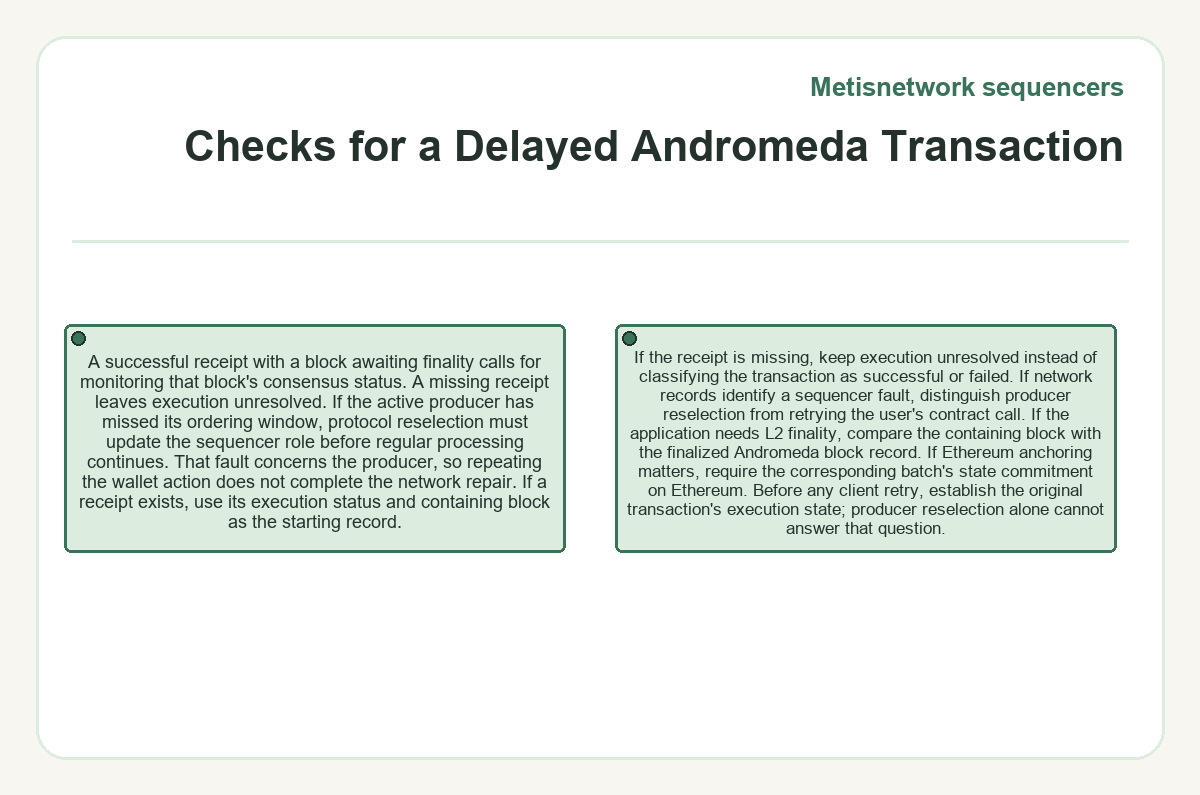
- If a receipt exists, use its execution status and containing block as the starting record.
- If the receipt is missing, keep execution unresolved instead of classifying the transaction as successful or failed.
- If network records identify a sequencer fault, distinguish producer reselection from retrying the user's contract call.
- If the application needs L2 finality, compare the containing block with the finalized Andromeda block record.
- If Ethereum anchoring matters, require the corresponding batch's state commitment on Ethereum.
Before any client retry, establish the original transaction's execution state; producer reselection alone cannot answer that question.
Sequencer Decentralization and Security Dependencies
Andromeda distributes responsibility for block production through its pool and rotation process, while Ethereum contracts and verifiers address additional parts of L2 security. A peer signature check establishes the validity of the sequencer's transaction signature. A state root commits to the resulting L2 state. Neither a signature check nor a state commitment alone establishes that the state transitions are valid. Sequencer availability, transaction ordering and state validity remain related concerns with different enforcement mechanisms.
Sequencer decentralization and fraud-proof deployment are separate engineering decisions. The 2026 roadmap lists proof-system upgrades and migration to Ethereum blob data availability as separate Andromeda milestones. A change in pool membership or the active sequencer cannot establish the deployment status of those mechanisms.
Receipt status supports earlier execution feedback; L2 finality adds sequencer consensus, while Ethereum anchoring adds the batch record on Layer 1.
Frequently asked questions about Metisnetwork sequencers
Can an Andromeda Pool Member Produce Batches Outside Its Sequencer Turn?
A sequencer node assembles batches only when the rotation list identifies it as the current sequencer. Membership in the pool does not give every node simultaneous production authority. The node obtains its position through the Adapter and consensus layer, checks it against the relevant block height and follows the active rotation state.
How Do Ethereum-origin Transactions Enter Andromeda's Sequencer Path?
Ethereum-origin transactions enqueued through a cross-chain bridge receive special handling by Andromeda's current sequencer. The sequencer creates a block containing the single enqueued transaction. This concerns the Ethereum-origin processing path, so it does not establish that every block of ordinary L2 transactions contains only one transaction.
Does the sequencer's Bridge Module Transfer Wallet Assets?
The sequencer's Bridge Module coordinates the consensus layer and the Metis node. Its processor forwards batches for MPC signing, while its listener monitors locking-contract events and block events. The canonical asset bridge handles deposits and redemption through separate contracts. The shared term bridge does not make these components interchangeable.
Are MPC Signing Addresses Replaced Whenever Sequencer Membership Changes?
MPC key resharing can update participating key shards without changing the pool's MPC address when sequencer nodes join or exit. The consensus layer coordinates this membership change. An unchanged signing address therefore does not establish that the same nodes continue participating, because key resharing and address replacement are different operations.
Do Public RPC Limits Reveal Andromeda's Sequencer Capacity?
An RPC service's request limit describes access to that service, rather than a direct measurement of sequencer processing capacity. For workloads exceeding a public endpoint's limits, access options include a private RPC endpoint or a replica node. These access choices concern requests and network data; they do not change the sequencer pool's consensus condition.
Will Locking METIS Guarantee Active Sequencer Status?
Locking METIS and applying to join does not guarantee an immediate place in the active sequencer set. When the set has reached its agreed maximum, a new applicant enters the waiting queue. An available place allows the next queued node to enter. Admission to the pool remains separate from selection as the current producer.